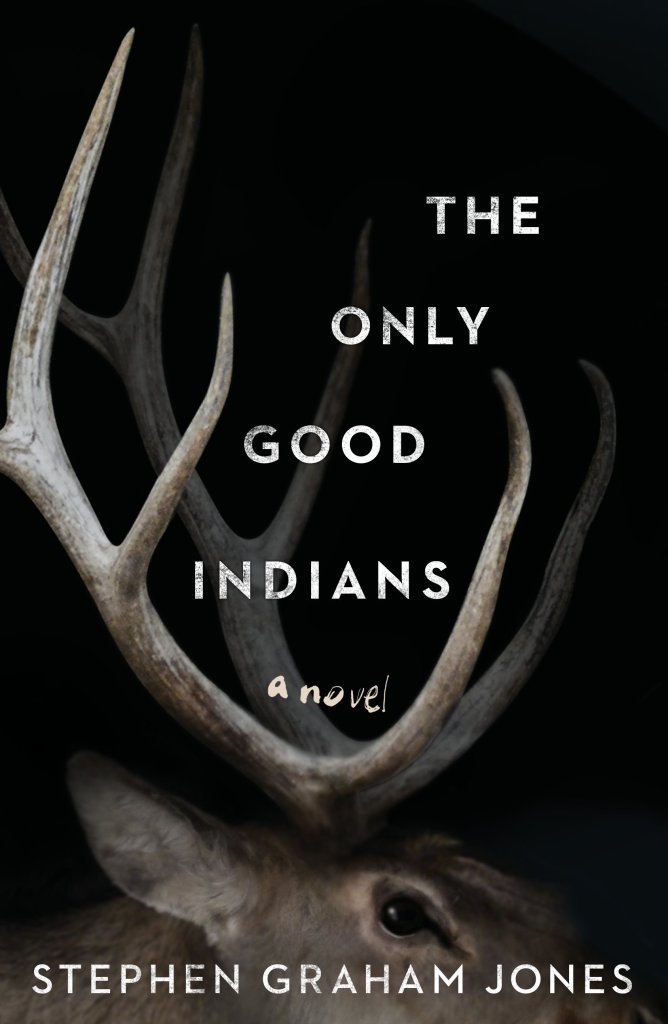
5 Stars. Out 7/14/20. Trigger warnings for body horror, animal killing, gore.
Image from Goodreads
The Only Good Indians by Stephen Graham Jones is a literary horror novel to take all literary horror novels. It’s an open, bleeding heart, beating with the force of broken families, old traditions, and bad decisions made by young men that have the unfortunate power to shape their futures. This book has been described as Peter Straub’s Ghost Storyset on the rez, and it absolutely has that vibe.
A decade ago, four young Blackfeet men decide to hunt where they shouldn’t and kill more than they need. Ten years later, a vengeful spirit rises up to settle the score. The men must face their pasts and their identities in a bloody reckoning. But the spirit won’t stop with them, it must turn to their loved ones as well.
I have never read a more inventive story, which is saying a lot because I’ve said that about at least two other books in 2020 prior to this one. Jones has blended many literary influences, Native cultures and beliefs, and applied unique formatting to The Only Good Indians. Once I began reading it, I could not put it down.
Anyone who reads Stephen Graham Jones knows that his work is so much deeper than just a horror story. Horror has the beauty of speaking real truths when treated correctly, and Jones wields that power often in his novels. Jones’ messaging in The Only Good Indians about tradition, respect, perseverance, resiliency, and family are powerful, as is his heartfelt assertion in the acknowledgments that all Native women should stay alive to thrive and flourish.
The Only Good Indians is bone-chillingly frightening, shockingly thrilling, viciously bloody, and full of an enormous amount of heart. Jones really killed it with this one.
Thank you to Netgalley and Gallery / Saga Press for providing me with an ARC in exchange for an honest review.
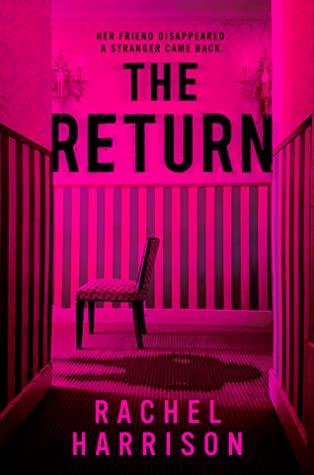
5 Stars.Out 3/24/20. Trigger warnings for eating disorders, body horror.
Image from Goodreads
Elise’s best friend Julie was missing for two years. Their friends Molly and Mae were certain she was dead. They had a funeral for her. And then Julie came back with no memory of the time she was gone.
Trying to get life back to normal, the four women decide to go on a girls trip to a trippy boutique hotel in the Catskills. But when they all get there and see Julie for the first time since her return, they realize something is very very wrong. And yet, no one can bring themselves to talk to Julie about it, not even Elise. Not until it’s too late.
The Return by Rachel Harrison is an amazing book, scary and thrilling with well crafted characters. Harrison blends absolute terror with humor and humanity. There are well-placed moments of levity, and even the most frightful scenes are injected with meaning beyond just a good scare.
This book an excellent examination of female friendship, especially with groups of women who have known each other for a long time–the history you bring up and the history you agree to forget; the wrongs done to each other that can build up; the resentment, the judgement, but also the deep love. What do you owe your closest friends? What do they owe you? What does it mean to really be there for each other? While this is obviously a horror novel and exists in the realm of the fantastic, it is very likely you have been in Elise’s situation before…trying to figure out how to help an old friend who is clearly having problems and could use support, but perhaps the baggage between the two of you is getting in the way.
In asking these questions and tackling these problems, The Return does that thing that I love best about horror, which is shine a light on real life struggles. I really loved The Return and recommend it to anyone who enjoys books about female friendship, the movie Jennifer’s Body, and/or folk horror (yup, there’s a bit of that in there).
Thank you to Netgalley and Berkley Publishing Group for providing an ARC in exchange for an honest review.
4 stars. Trigger warnings for child neglect, torture, death of a parent, graphic violence.
Image from Goodreads
I’ve been blessed lately with books that feel like they’ve come right out of The X-Files, and as a massive X-Files fan this is obviously great for me! I wasn’t sure what to expect from Bent Heavens, but I knew Daniel Kraus’ impressive track record. Despite not having read any of his work in the past, I felt like I could trust him. That trust was in great jeopardy for a lot of this book, but by the end Kraus found himself in the camp of authors that I will automatically read no matter what.
Liv Fleming’s father is gone. He disappeared one day, for the second time, but this time he didn’t come back. Was Lee Fleming right? Did aliens truly abduct him to conduct brutal experiments? Or did he just go crazy? One thing was clear, he was very unwell. Liv has done her best to move on: she has new friends and participates in new activities, but her past refuses to leave her. Her mom is an alcoholic trying to hold down two jobs and her old childhood friend, Doug, will not let her father go. He dutifully follows Lee’s instructions, confounding as they are. Every week Doug and Liv check the traps Lee built to keep them safe from the beings he swore took him.
Liv can’t find it in her to cut Doug off, to tell him she won’t play along anymore. But right when she feels herself about to break free, she finds something in one of Lee’s traps…something that looks startlingly extraterrestrial. What happens next, what she and Doug do and what Liv discovers, is so horrific and heart-breaking. This book comes to its horror designation honestly.
Doug falls down a horrific and all too real rabbit hole. He does research on “enhanced interrogation techniques” from the Bush era and makes it his mission to go through each technique with the creature. At first it was to force information out of the creature about what happened to Lee Fleming. But that flimsy excuse goes out the window fast, and it soon becomes solely about the torture.
This goes on for at least a third of the book. It felt like they were torturing a dog. I was about to give up. It was so brutal and hard to read. But just in time, Liv decides to dig a little deeper and break out of Doug’s rageful gravity. What she discovers, however, only compounds the horror of her and Doug’s actions.
I think it’s important to mention here that the afterword is a note from Daniel Kraus concerning the Senate Intelligence Committee report on CIA torture, which makes the purpose of the book and the actions of some of the characters painfully clear. This book is a statement against torture. It is a brutal and honest look at what governments have sanctioned under pathetic if not fully false pretense. Humans have a lot of evil potential inside of us, and it doesn’t take much to let that flourish. But we also have a lot of good, powerful enough to conquer that evil.
This book feels a lot like The X-Files in many ways: the “something strange in a small town” vibe and the science fiction twist, but most importantly the conspiracy aspect. The reminder that a healthy distrust of authority is critical. It’s a poke in the side to remind us that the truth is out there, and we need to be brave enough to shine a harsh and unforgiving light on it. That is the only way to let the good in to conquer the evil. Sometimes that can take extreme bravery and courage. This in no way condones irresponsible conspiracy theory rhetoric and behavior. There is definitely a line between “healthy distrust” and harmful nonsense.
I can’t say Bent Heavens ends happily, but it does ends satisfyingly. The strongest moments are definitely in the beginning and later portions of the book. I know that Kraus is making a point with his extended focus on torture, but to me those scenes were the weakest.
In addition to the intense plot and excellent twists that Kraus works in throughout Bent Heavens, the writing itself is really great. You get swept up in it and carried through all manner of horrors and action. Kraus also captures the sensations and experiences of grief wonderfully. Liv struggles through the entire book with the trauma of losing her dad in such a public way and without much closure. It colors everything she does, every decision she makes. Putting her actions up against her friend Doug’s (who also viewed Lee as a father) is a wonderful way to compare what grief can do to individuals.
While Bent Heavens is classified as a Young Adult novel, I would only recommend it to older teens. It’s a bit of a roller coaster and will surely have readers divided. But despite struggling through a chunk of the book, I found that it was worth it in the end.
Published 2/25/20. Thank you to Henry Holt and Co. (BYR) and NetGalley for providing an advance review copy in exchange for an honest review. Review originally published on jocelyniswrong.com.
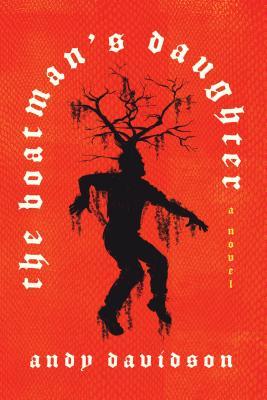
4 Stars. Trigger warnings for violence against women, self harm, assault, sexual assault, lots of blood and gore.
Image from Goodreads
Do you like action? Brooding? Cults? Women highly skilled with a bow and arrow? Ancient swamp magic? REVENGE?? I’m sure your answers were all ‘yes’, and so I highly recommend to you The Boatman’s Daughter by Andy Davidson. This book is a thrill ride with plenty of bloody action, terrifying folk magic, and beautiful found family vibes. It feels like Winter’s Bone meet Beasts of the Southern Wild, and it’s amazing.
Miranda Crabtree is an orphan and has been since her father disappeared in the bayous of Arkansas when she was eleven. The only evidence left behind was a shotgun shell and a baby Miranda could have sworn was dead when her father and an old witch took it deep into the woods. Miranda barely escaped that night with her life. Something in the bayou wanted her.
That night, Miranda lost the last of her family, but she gained a new brother in the abandoned baby and a new grandmother (Baba) in the old witch, who found her and nursed her back to health. To keep them safe, Miranda aligns herself with bad men: an unstable and washed up preacher/cult leader, a weed grower, and a corrupt and murderous constable who tries to hurt her in more ways than one. Luckily, Miranda knows how to handle herself. When the preacher and constable start making some dangerous moves, Miranda finds herself having to fight for not only her life, but the lives her brother, her Baba, and a new arrival who turns out to be more significant to her family and the people of the bayou community than Miranda realizes. The balance of the ancient magic in the swamps depends on it.
Turning to her learned survival skills to defend herself and her family, Miranda also has to turn to a darker more dangerous power. Her Baba is a true witch, a woman deeply connected to the spirits of the bayou and the spirits brought over from her homeland. Her power and magic has deep roots in Slavic folklore, and they seem to feel just as at home in the American South as they do in Europe. But this power does not come without sacrifice and pain (and blood). And even with those sacrifices, these spirits are not in the business of customer satisfaction, if you know what I mean. Miranda must take this risk and call on the power of the bayou, unsure of if and how it will answer.
The Boatman’s Daughter is over 400 pages long, but the writing sucks you in and seamlessly ushers you through the split narratives. Davidson’s writing is so vivid, you can feel the sticky heat of the bayou as you read. He handles extreme and graphic situations with a kind of beautiful fluidity. This book is not without its gore and trauma on the page, and yet Davidson has a skill for making it feel significant and real without over sensationalizing.
The characters are rich and inventive, and some of them are absolutely terrifying. I will also give Davidson credit for writing what I thought was a wonderful female character. Miranda is strong, vulnerable, and competent. She’s incredibly skilled, but woe to the first person to tries to call her a Mary Sue. I loved reading her and going on her journey.
I would absolutely classify this book as horror, but it’s an interesting blend of subgenres that make it feel different from a classic horror novel. The real world horrors are front and center through most of this one. And while there is a heavy dose of paranormal creeps, most of those elements appear at the end. So if you like slashers and thrillers, I would definitely recommend picking up The Boatman’s Daughter.
This was my first experience reading Andy Davidson and I can 100% say that I will pick up anything else he writes in the future.
Published 2/11/20. Thank you to Farrar, Straus and Giroux / MCD x FSG Originals and NetGalley for providing an advance review copy in exchange for an honest review. Review originally published on jocelyniswrong.com.
4 Stars.Trigger warnings for hoarding, death of a loved one.
Image from Goodreads
A few years ago, I went with my Mom to stay with her and my Aunt at my aunt’s new cabin on a kettle lake in upstate New York. Kettle lakes look like ponds, but they were formed by ice blocks melting many a year ago. Bloody Pond, the kettle lake my Aunt has her cabin on, is spring fed so the water is crisp and clear. It’s very refreshing! My Aunt’s cabin is set deep among some pines, and it feels very bewitching to be there.
We had a lovely weekend in her adorable cabin, swimming, reading, eating, and drinking. There was, of course, an amazing campfire, and we stayed up late talking and laughing. But the later we stayed up (and the more red wine I drank), the more I couldn’t stop looking out into the pines. It got really creepy. What could be in those pines? Were there creatures watching us? What kind of creatures?
I was also raised on a very healthy dose of creepy folklore. My family has a lot of Scottish and Irish blood, so stories of changelings and brownies and selkies etc. were very common. I’m convinced my mom is in good with some faeries. I think it’s because of all of this that I loved T. Kingfisher’s The Twisted Ones so much. I think I love folk horror best now.
Mouse lives in Pittsburgh (heyo, local gal!), and she doesn’t see much of her immediate family. Her Aunt raised her after her Mom died, but she talks to her Dad every week on the phone. Her Grandma lived in rural North Carolina (I also have family in North Carolina…too many coincidences), but now that both she and her Step-grandpa are dead, their house is just sitting vacant. Mouse’s Dad calls her up and asks a huge favor…would she please go down and clean the house out so they can decide what to do next with it? She can’t say no.
The house is a disaster. Her Grandma was at hoarder status before her death, and Mouse knows it’s going to take forever to get through the piles she left behind. But she’s got a radio and her lovable (if doofy) coon hound Bongo by her side. She also has her Step-grandpa’s old journal for reading material, and boy is it a doozy! He talks about carvings on stones, twisting about like the twisted ones, laying down like the dead ones, poppets, not being able to sleep, and of course how generally awful Mouse’s Grandma was.
Mouse gets hooked on the journal and begins searching for a book that her Step-grandpa keeps referring to, but as she hunts the stuffed house for this missing book (or anything related to her Step-grandpa’s ramblings), things go off the rails. I don’t want to spoil anything, because the plot is so twisted and fun, but Mouse and Bongo soon learn that they are in a place where the veil between their world and a different, more ancient and magical one, is very thin. The woods behind the house are a dangerous place. There are monsters out there, and Mouse’s Step-grandpa knew it. The monsters knew about him too, and now they know about Mouse.
I blew through The Twisted Ones! T. Kingfisher’s writing is so entertaining and juicy. The imagery is rich and shocking, the characters are well developed and a ton of fun, and the lore is fascinating. As a piece of folk horror, I found it gripping and compelling. When you take old-country stories and beliefs and you bring them into stark contrast with the modern era, sometimes the juxtaposition itself is unsettling. This book goes way beyond unsettling, however. There is one image that I will never get out of my head. Now, when I stare out at a sea of dark, damp pines at night, I will think about that image and probably run screaming back into a well-lit house.
But The Twisted Ones isn’t a beat-you-over-the-head scary book. It’s full of creeping dread, and there are some horrific images (as mentioned above), but it’s mostly a well told adventure with some solid scares and a well developed setting. Something I appreciate the most about it is its sense of humor. Mouse is hilarious, and the neighbors she makes friends with at her Grandma’s house are so fun you find yourself wanting to have dinner with them yourself.
The Twisted Ones is a well-rounded novel for those who are intrigued by the darker side of things. It’s steeped in old-timey lore and family secrets, with a healthy dose of humor and adventure. If you enjoyed The Ritual by Adam Nevill or The Blair Witch Project, you’re sure to enjoy The Twisted Ones. But I recommend this book to both horror and non-horror readers alike! It’s truly a romp of a story.
Published 10/1/19. Thank you to Gallery / Saga Press and NetGalley for providing an advance review copy in exchange for an honest review. Review originally published on jocelyniswrong.com.
I say with no exaggeration that Sara Faring’s The Tenth Girl contains the biggest twist and flip I have ever witnessed in fiction. This book is a slow burn that ends in the most unexpected way. In my wildest dreams, I could never have predicted what happens at about 80% of the way through. I can’t even truly review it because I don’t want to spoil anything!
A split perspective narrative, The Tenth Girl bounces back and forth between Mavi, a young woman in 1970s Argentina beginning work as an English teacher at a secluded prestigious boarding school in Patagonia (such a stunning place on this earth), and Angel, an American teen in the 21st century (I think) suffering from the loss of her family. Through a series of events, Angel’s spirit finds itself at the very same boarding school as Mavi, and she soon learns that other spirits are hunting and feeding from the residents of the school.
Angel and Mavi make an unlikely connection but strong, and together they decide to fight the seemingly paranormal forces bent on destroying everyone and everything around them. These forces seem linked to an old indigenous Zapuche (mapuche) legend, where the tribes attempted to protect themselves and their lands by inviting back the spirits of their departed, but instead opened the floodgates of hell. The only way to quell The Others, as these destructive spirits are called, is to sacrifice a young girl.
If it seems like I’m being cagey here with details, it’s because everything I thought I knew about this book through 3/4ths of it is a lie. One of the biggest twists I have ever experienced in a book (perhaps even bigger than Gone Girl), occurs with only a fourth of the narrative to go, and from there on out it completely defies genre and expectations.
Up until that twist, I felt like The Tenth Girl was really dragging, lacking in character development, and uninventive with its plot. Most of the book, and it’s not a short book, is rather dull. After the twist, those potential faults are explained away, but I honestly don’t know if I like it any better. I wish the twist occurred sooner, and we got to spend more time acclimating to the new reality of the situation. And what Faring explores in the last ten percent of the book is more fascinating than anything that happened in the preceding ninety. I desperately want her to write THAT book, exploring the events that lead us to the conclusion and after.
Faring’s writing is beautifully descriptive, but it can drag in places. The Tenth Girl is written for a Young Adult audience, but it contains some very dark creepy moments. As I mentioned, it is hard for me to nail down an actual genre for this book, but predominantly I would say it’s a YA psychological thriller with elements of horror and historical and science fiction.
The Tenth Girl is Faring’s debut, and while I only rated it a 3/5 stars, I would definitely pick up another of her books in the future. She intrigued me with this one, and her sensational end saved it for the most part. Once you’ve read it, I’d really like to know what you all think!! It’s really frustrating to not be able to talk about the most interesting part of this book.
Published 9/24/19. Thank you to Macmillan Children’s Publishing Group and NetGalley for providing an advance review copy in exchange for an honest review. Review originally published on jocelyniswrong.com.
Published 9/24/19. Thank you to Macmillan-Tor/Forge and NetGalley for providing an ARC. Review originally published on jocelyniswrong.com. Trigger warnings for child abuse, sexual abuse/assault, murder, violence, family death.
This is a nasty little book, brutal and beautiful. To call it simply atmospheric would be doing it a great disservice. Jennifer Giesbrecht’s debut novella The Monster of Elendhaven is absolutely phenomenal. In a short 160 pages, Giesbrecht paints a world of cold, dark filth. It drips with pain and sorrow. The characters are wretched but fascinating and fully developed. I use these descriptors not as a way to dissuade you in reading it, but to let you know what arena you’d be playing in. The characters are wretched, yes, but you love to follow them in their dastardly plots. The setting is stark and harsh, but you will not be able to look away. And while the story is creepy and gory, it has moments of true tenderness and humor.
In The Monster of Elendhaven, a superhuman man named Johann stalks the dark and seedy streets of Elendhaven, acting as the city’s own Jack the Ripper of sorts. There’s something unique about Johann though: it appears he can’t be killed. He’s tried. Multiple times. When he encounters Florian, a man from one of Elendhaven’s oldest families, he sees a kindred spirit. Soon they team up, Johann acting as the strong arm for Florian’s dark revenge fantasies. But even the best laid of evil plans can experience some hiccups. Someone is hunting Florian, and they mean to kill.
Magic plays a huge role in this book, but it’s the kind of magic that you need to look at out of the corner of your eye. Sorcerers and magic used to fill the world, but as time passed it became dangerous to be a sorcerer. It was punished, shunned, and bred out of society…but not entirely. Elendhaven, being a fantasy mirror of a Germanic/Nordic country, has old magic and old lore that does not forget the truth behind the universe. It is a place where fantastical things can still happen. I love settings like this, that exist in the spaces between the modern mundane world and an older magical world.
What Giesbrecht does in such a short space is so impressive. She gives us a fully realized story, equipped with rich characters, a visceral setting, a deep mythology, and a satisfying end. And while we only get a fragment of the lore this world contains, it is robust and offers the appropriate support to the tale at hand. I could read a whole series based on these characters or set in Elendhaven or its surroundings.
The Monster of Elendhaven is like if Tim Burton and Rob Zombie collaborated on a film together. It’s a Dickensian tale on crystal meth. It will chill you to your core but leave you wanting more. I wait in eager anticipation for whatever Giesbrecht publishes next!
Published 9/24/19. Thank you to Inkshares and Netgalley for providing an ARC. Review originally published on jocelyniswrong.com. Trigger warnings for death of a parent/spouse.
I grew up on a lake. My grandparents had an adorable lake house on one of the Finger Lakes in upstate New York very close to the small town I grew up in. We spent most of our summer days making the quick drive to their house and enjoying the fresh, cool water, the slight breeze, the gorgeous and magical woods, and the secret worlds we created. There were caves, waterfalls, glens, clearings, fields of wild flowers, and of course the lake itself. We learned how to swim and sail on that lake, and spent countless hours sunbathing on the dock and telling ghost stories around the fire on the beach. Our favorites were about the ancient monsters that lived at the bottom of the deep Finger Lakes, which were formed by glaciers making giant cuts in the land thousands of years ago.
Lake houses mean true peace, serenity, and happiness to me, so this book hit me like a ton of bricks. I was always on the look-out for ghosts in and around my grandparents’ lake house, but Scott Thomas’ Violethas made me grateful I never found them!
After Kris’ husband is killed in a crash, Kris takes her young daughter Sadie to her family’s lake house on Lost Lake in Pacington Kansas to get away from the memories and the prying eyes of family for the summer. Kris hasn’t been back to the lake house in thirty years, since she was a child herself. Her memories of the place are happy and full of joy, and she thinks the house could help her and her daughter handle the grief of suddenly losing her husband. The issue (one of many, as it turns out) is that the lake house hasn’t been touched in years. It has been neglected and is now overgrown and even rotting in some places. And it becomes very clear early on that the state of the lake house mirrors the state of Kris’ soul, and just like with her own trauma, Kris assumes she can just slap a coat of paint over it and it will get better.
Not long after Kris and Sadie reach the house, Sadie starts to act very peculiar. Her behavior becomes increasingly erratic. As Kris struggles to decipher what is happening to her daughter, she begins to uncover dark truths about her own past and the history of her family’s lake house that she repressed for years. There was a reason her father never took her back after the summer of 1988, after her mother died. There was a reason why everyone who tried to rent the place for the summer always asked to switch to a different house. There was a reason her father wanted to let the house rot after his own death. And now Kris has to face this truth head on to save her daughter and herself.
I know this summary makes Violet sound like one big metaphor for past repressed trauma, and it is, but don’t worry…it’s full of terrifying paranormal shit too. There were moments during this book that had me on the edge of my seat with my hair standing on end. It truly terrified me. I really enjoyed Thomas’ use of the paranormal concept of tulpas, which is criminally underutilized in my opinion. But as a metaphor for how we manage past and present family trauma, Violet works wonderfully! As my father-in-law says, if you keep sweeping shit under the rug, one day you’re going to trip over that rug.
Thomas’ writing is cinematic and sweeping. He takes his time with descriptions and really lets you sink into a scene. He reminds me of Stephen King in that way. I felt that Violet showed a lot of similarities to Pet Sematary in particular, especially concerning the questions of family, death, and the limits (or lack thereof) of grief. Good horror addresses the nasty truths of life. Thomas has done that here, and he has beautifully crafted a story that all readers can relate to whether they believe in ghosts and tulpas or not.
Throughout the book, music is successfully used to usher in both the beauty of the past and the pain. My lake house memories also have a soundtrack that feels like warm summers, cookouts, laughter, and family. If those songs were suddenly perverted to work directly against those associations, I’d probably lose my mind. This is exactly what Thomas does to Kris, and I loved it. I have to tip my hat to anyone genius enough to transforming “Blackbird” by the Beatles into one of the most horrifying songs in the world. From now on, every time I hear a college dude with an acoustic guitar clumsily strumming that melody on the quad of the campus I work on, I will have to replace my eye roll with a shudder of pure terror!
“Blackbird” aside, I would like to request that someone make a Spotify playlist with all the titles mentioned throughout the book, because they are some of my favorite songs of all time. Whoops, looks like I did that myself.
Out 9/17/19. Thank you to Pantheon and Netgalley for providing an ARC. Original review posted to jocelyniswrong.com. Trigger warnings for suicide, child abduction, child abuse, child murder, and inappropriate teacher/student relationships.
There are monsters in the world, unspeakable evils that rob us of that which is most precious to us. Life can break your heart and rip you apart, but Noah Turner has more to contend with than the familiar horrors of human existence. Noah can see monsters, like real monsters. Big harry creatures. And they can see him too.
Shaun Hamill’s A Cosmology of Monsters is an incredibly touching story about the Turner family. What starts off as a cute love story quickly turns to sorrow as Harry and Margaret Turner and their three children face tragedy after tragedy over the years. But in the midst of their struggles (struggles that many of us would recognize and be acquainted with), a fantastical element rears it’s furry, sharp-toothed head. A true monster has had its sights on the Turner family for decades, and Noah, the youngest, decides to let it into his home, his family, and his heart. What Noah doesn’t know is that his father also saw monsters, and his mother knew something was wrong.
I knew from the cover art that this was a book I needed to pick up. Once I read the synopsis I was hooked, and I couldn’t put it down. This stunning literary horror debut hit me in all the right places. I was up way past lights out flipping the pages, fully invested in the Turner family’s story and the monster(s) that haven’t stopped haunting them for generations. I couldn’t get enough of the throwback 80s/90s vibes mixed with Lovecraftian horror! Despite it being a horror/fantasy novel, I found it oddly relatable.
Not only did Hamill tell an amazing and spooky tale, but he successfully created a cross-genre masterpiece. When people think of horror, their minds usually go to slashers or haunted houses. It is actually an incredibly rich and diverse genre with a little something for everyone. The beauty of horror is that it can act as an incredibly effective mirror to society. The really timeless horror writers recognize this and build their spine-tingling tales on elements rooted in real life.
Good horror is like a good lie, there’s a lot of truth mixed in with the rest. In A Cosmology of Monsters, I would say that truth element is generational trauma. The Turner family faces a lot of hardship, but their biggest struggle is one of communication and forgiveness. It’s a story of regret, reconciliation, and family healing. But don’t get me wrong, it’s also about big scary monsters and a hidden inter-dimensional city hungry for your soul. Don’t worry, there are true horror elements wrapped up in the interpersonal family drama. Hamill’s writing is so beautifully descriptive that it will make you cry and shiver in equal measure.
A Cosmology of Monsters has absolutely landed itself on my favorites of 2019 list. If you enjoy family sagas, literary fiction, horror, or science fiction I highly recommend this debut novel by Hamill. I definitely recommend it if you are a fan of the TV shows Stranger Things and This Is Us (weird, I know). I would also compare A Cosmology of Monsters to Lovecraft Country by Matt Ruff, both pulling on Lovecraftian elements and involving family stories over generations.





 Forgotten Corners